
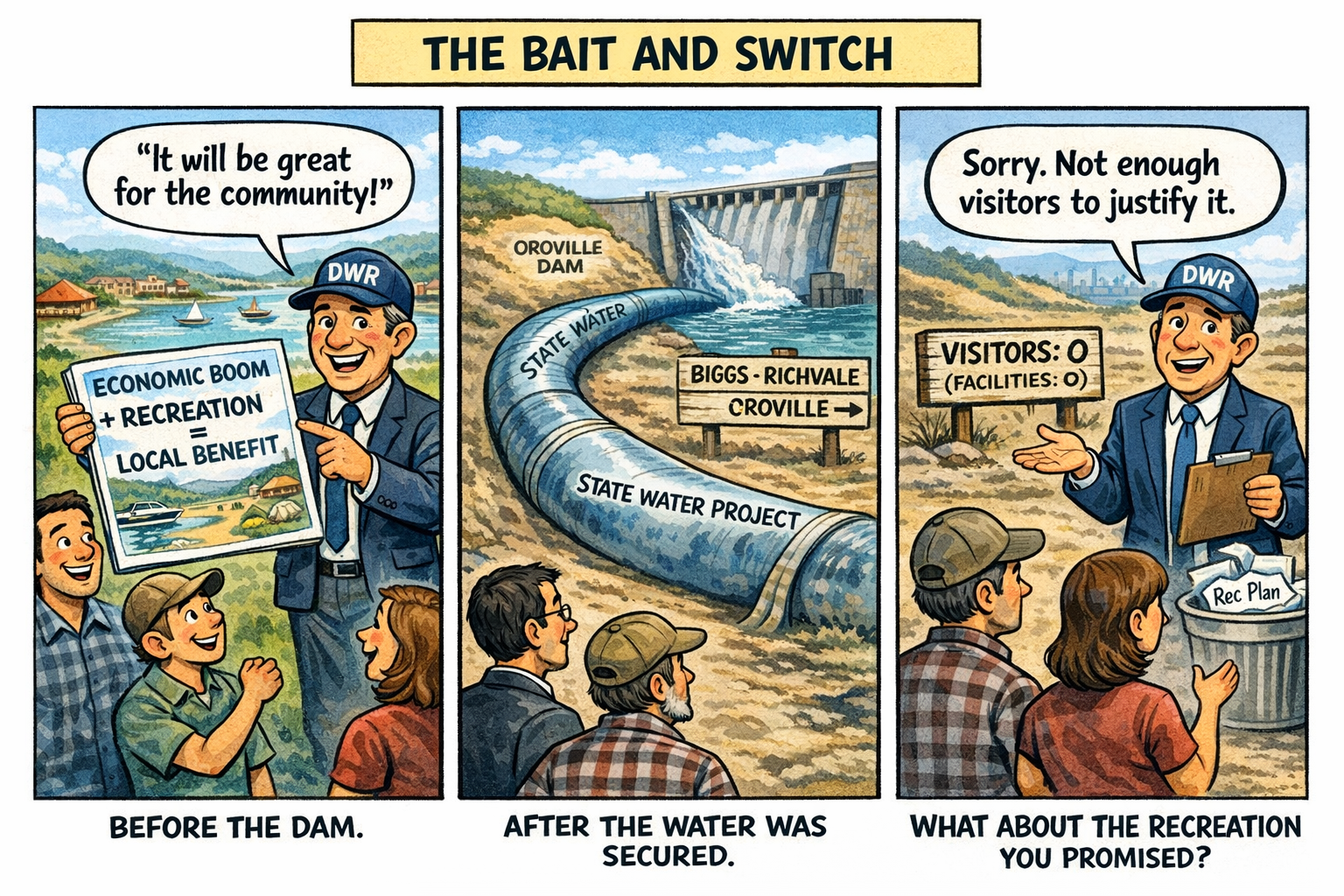
DWR promised to attract tourists with recreation facilities, then cited the lack of tourism as justification for not building them.
You don’t blame low turnout at a concert you never held.
Rome had aqueducts. Manhattan has the Erie Canal. And California, arguably the most audacious economic experiment in human history, has the Oroville Dam.
Rising 770 feet above the Feather River, Oroville Dam is not just the tallest dam in the United States. It is the linchpin. The keystone fueling the 4th-largest economy in the world. Strip it away, and the Central Valley, which feeds a nation, goes dry. Southern California's 20+ million people scramble for water. 2.2 billion kilowatt-hours of annual electricity, enough to power every home in Butte County for two years, goes away.
This is what infrastructure actually means. The invisible skeleton inside the body of civilization that the average person only notices when it breaks.
Authorized by the California Legislature in 1951, completed in 1968, and operated by the Department of Water Resources (DWR) ever since, Oroville Dam is the cornerstone of the California State Water Project, a vast machine that captures the snowmelt of the Sierra Nevada and sends it hundreds of miles south, turning desert ambition into agricultural reality.
That water didn't just sustain California. It fueled the rapid growth of California into the largest economy and most populous state in the nation. Agriculture flourished in what should have been scrubland. Entire regions invented themselves on the assumption that the water would always come, and it did, because of one dam, in one county, on one river.
The county is Butte. The river is the Feather. And what happened there is a masterclass in how a society can be simultaneously magnificent and cruel.
THE TERMS OF THE DEAL
Every great heist requires the appearance of fairness.
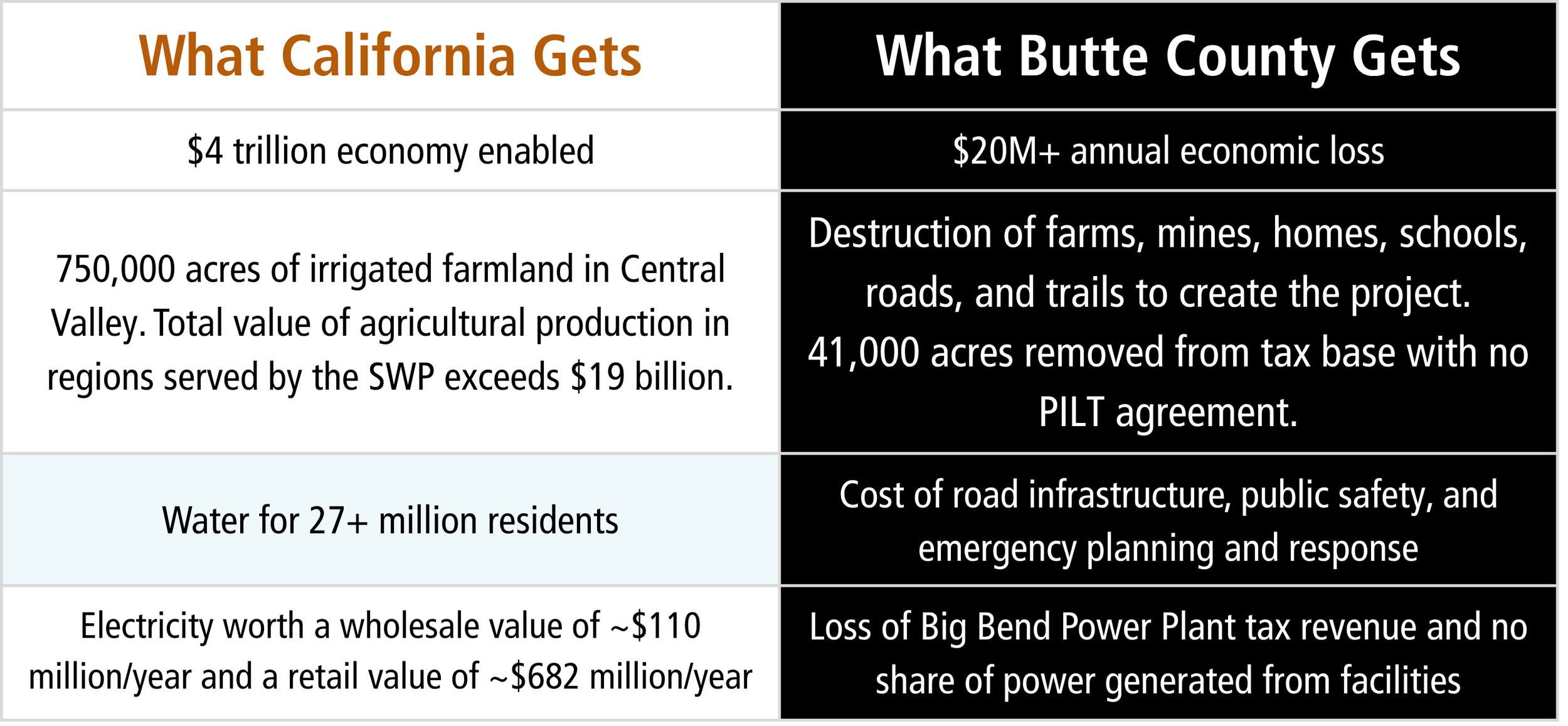
When the State proposed the Oroville project in the 1950s, it didn't pretend the impact on Butte County would be painless. Thousands of acres of land would be inundated, existing recreation sites would be eliminated, future development opportunities would be foreclosed, and property tax revenue from the removed 41,000 acres would never be assessed.
But there was a federal catch. Because the dam would generate hydroelectric power, the State needed a license from the Federal Power Commission, now the Federal Energy Regulatory Commission, or FERC. Think of FERC as the referee in any deal involving dams and rivers: a federal watchdog ensuring that when hydropower projects are constructed and operated, the public interest is protected. FERC identified recreation as a required project purpose, meaning the State had to develop recreation facilities as a condition of its license. It couldn't just take; it had to give something back.
So, DWR developed a proposal. And it was not a small proposal.
The recreation plan submitted to secure the federal license was a vision likened to that of Lake Tahoe. Not a modest campground and some parking stalls, but a once-in-a-lifetime transformation. Campgrounds, marinas, a restaurant with a 250-person seating capacity, a snack bar accommodating 100 people, a visitor center with gift shop, two auditoriums for audio-visual presentations, a monorail, trackless train, steam train, tours of the powerplant through an open 40-seat bus, 5 beaches, day-use areas, picnic facilities, walking trails, and shoreline access would attract visitors from across California. The State projected 12.5 million visitor-days annually, presenting the reservoir as the economic engine that would replace what the dam had taken away.
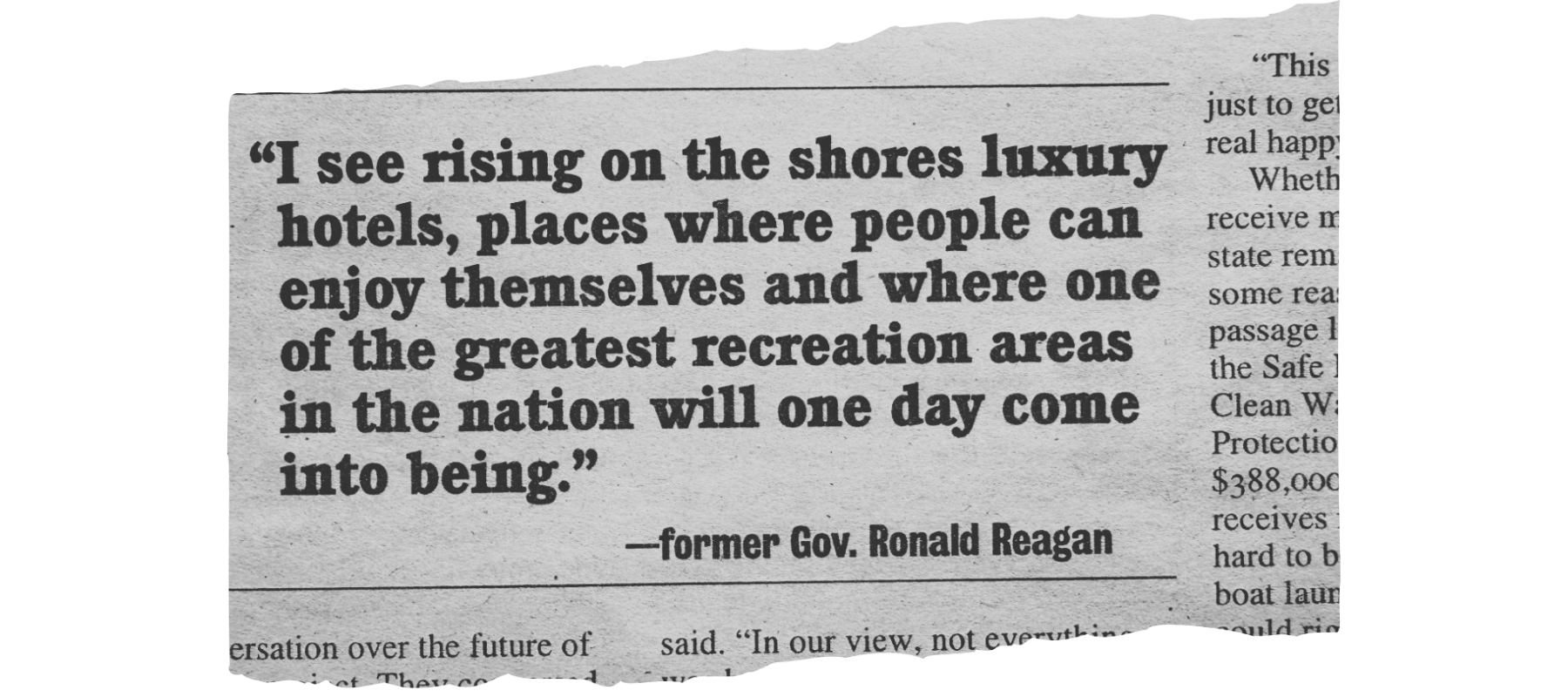
“The construction boom in Oroville is over. But it will be followed by an even larger growth as recreation brings millions of Californians to the lake, which we see forming.” – Ronald Reagan, Oroville Dam Dedication Speech, 1968
However, once the State secured its water, Butte County was left with the burden of the dam and more than $20 million in annual losses, while the water and the prosperity it created continue to flow south.
Today, Lake Oroville receives roughly 2 million visitors annually, less than one-sixth of what was promised. Rather than fulfill the development that was supposed to create demand, the State reversed course. Officials began citing the lack of tourism as justification for not building the very recreation facilities that were intended to attract visitors in the first place, thereby contradicting the philosophy used to sell the project. Meanwhile, the economic burdens remain squarely on Butte County.
WHAT THE STATE PROMISED
Monorail & Trackless Train – for transporting visitors to the Kelly Ridge Visitor Center
Steam Train with 800-foot tunnel (six-mile one-way trip along the south bank of Feather River)
Restaurant (250-seat) & Snack Bar – Kelly Ridge Visitor Center
Lodge Facilities on Kelly Ridge
California Resources Exhibit – Kelly Ridge Visitor Center (outdoor contour map of the State of California, nearly the size of a football field)
Two Auditoriums for audio-visual presentations (250-seat, each) – Kelly Ridge Visitor Center
Five Beaches & Picnic Areas
Loafer Creek Amphitheater (100 car parking)
Loafer Creek 2 Children’s Play Areas
4 Ranger Residences – Loafer Creek
Riding Stables – Loafer Creek
Public Service Facility (food) – Lime Saddle
Restaurant & Snack Bar - Thermalito Forebay
Multiple Public Service Facilities (food) – Thermalito Forebay
Par 3 Golf Course - Thermalito Forebay
Powerplant Tours, served by an open 40-seat bus
Kelly Ridge Visitor Center & Gift Shop
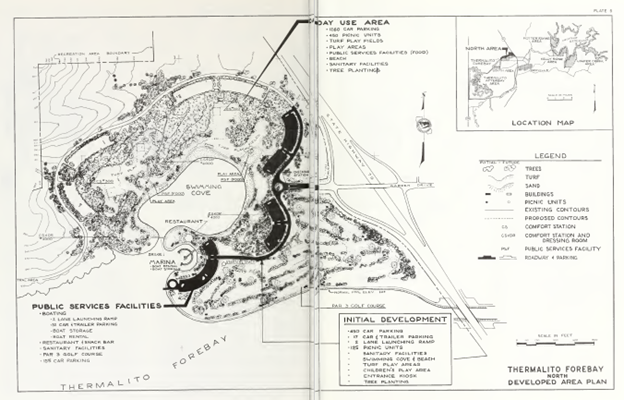
Map from DWR's Recreation Plan (Bulletin No. 117-6) highlighting proposed recreation facilities. Click the image to view a larger version on page 22.
THE LEDGER
Numbers don't lie. People lie about numbers.
Twenty million dollars a year. Every year, for decades, while the water flows south and a trillion-dollar economy benefits from infrastructure that a small Northern California county subsidizes with its costs for patrolling lake roads, responding to emergency and medical calls, maintaining road infrastructure, and supporting the public safety presence required by visitors.
WHAT THIS ACTUALLY IS
Butte County had something California desperately needed: water. The State needed to borrow that asset, permanently, and it offered a vision of mutual gain. A recreation wonderland. 12.5 million tourists a year. Then it took what it needed and moved on. The pattern is ancient: those with leverage extract value from those without it, and dress the transaction in the language of shared prosperity.
What makes Oroville different is the paper trail. The State wrote it down. The promises are in the license application, in the recreation plan, and in the projected visitor counts submitted to the federal government. The gap between what was promised and what was delivered is not a matter of interpretation. It's arithmetic.
And arithmetic, unlike politics, doesn't have a spin cycle.

Now, after more than half a century of waiting, the window is open. The federal operating license for the Oroville Dam is up for renewal before FERC. That license, the same mechanism that compelled the original recreation promises, must be renegotiated.
When FERC issues licenses, it requires the applicant to demonstrate that the project serves the public interest. It weighs the impact on communities. It sets conditions.
The lever exists. The question is whether anyone will pull it.
THE ASK
Before the next license is signed, the first promise must be kept.
Butte County is not asking California to drain the reservoir or stop the water. The dam stays. The water flows. What Butte County is asking is simpler, and more fundamental: honor the deal.
Fulfill the Original Recreation Promise:
DWR made specific, documented commitments to FERC as a condition of its license. Those commitments were the price of admission. Before a new license is granted, the State must deliver what it promised: a genuine, funded, executed recreation plan that creates the economic engine Butte County was told it would receive.
Establish a PILT Agreement Now:
Payments in Lieu of Taxes are not charity. They are the basic acknowledgment that when a government removes taxable property from a community's base to serve the broader public, that community deserves compensation. Seven million dollars a year in lost property taxes is not an abstraction; it's schools, roads, and emergency services that Butte County residents do not have. A PILT agreement must be a non-negotiable condition of the new federal license.
"FERC holds the pen. Before it signs the next 50-year license, it should ask one question: was the last one honored?"
This is the moment. Relicensing proceedings move slowly, but they move, and once a new license is issued, the terms are locked for decades. FERC has the authority and the obligation to make this right.
California tells a story about itself: progressive, equitable, a model for the nation. That story has an asterisk. The asterisk is a rural community at the base of a 770-foot dam, waiting for a promise made before most of its residents were born.